
Snow plow insurance, built on the truck and the lot
A plow on a truck is an auto to the insurance forms, so commercial auto is the core line for a plowing business and a personal policy may not cover the work. General liability answers for the lot, and the claim that defines the trade, someone falling on ice hours after you cleared it, needs the snowplowing operations endorsement to stay inside the liability policy. Whether a dedicated plow truck's coverage can rest in summer has a bounded answer: an endorsement exists for vehicles idle 30 days or more, and which coverages it touches, what your state requires of a registered truck, and whether your carrier offers it are the three questions to ask.
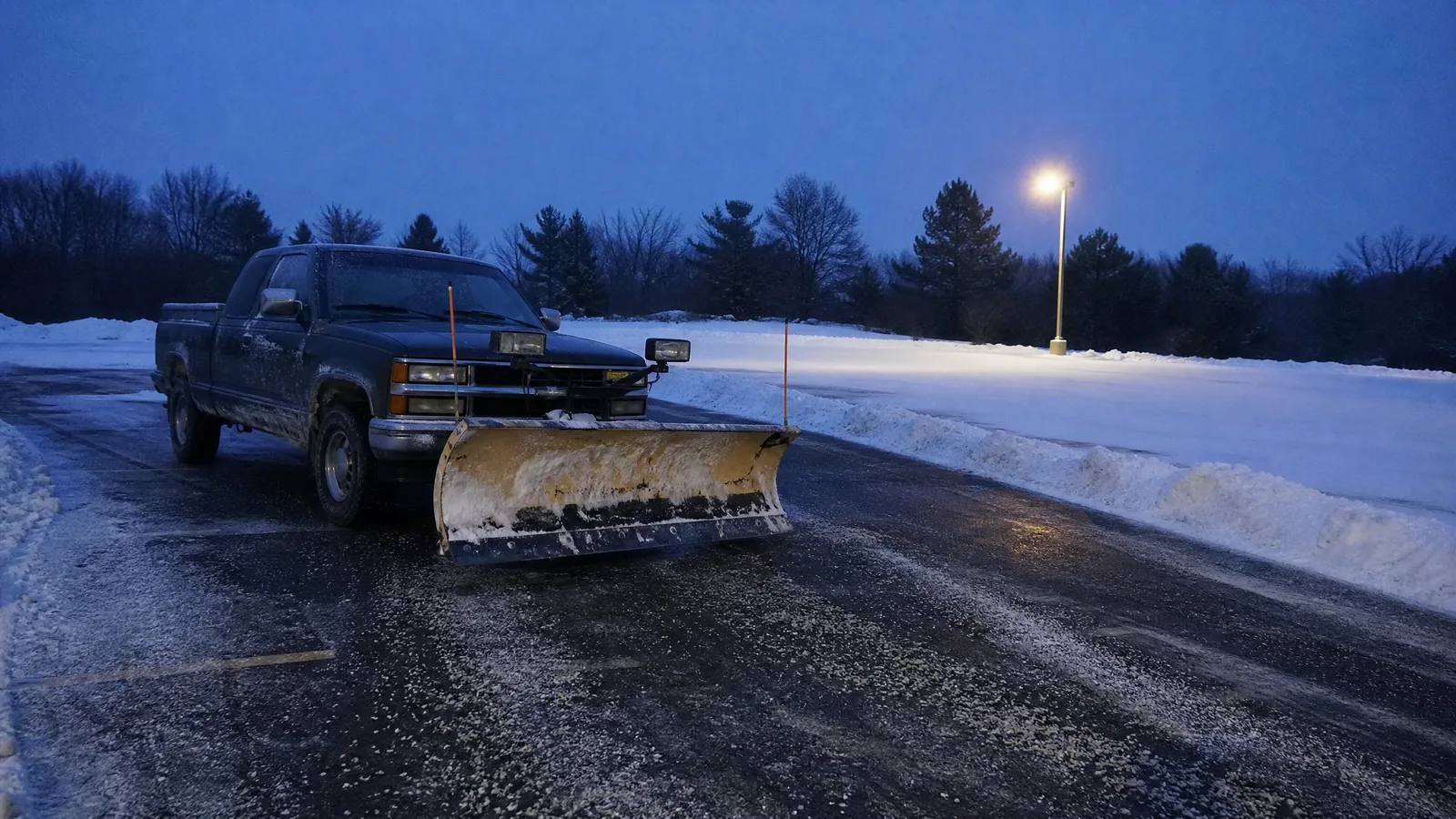
Commercial snow plow insurance starts with the truck
Every other trade on this site leads with general liability. This one leads with the vehicle, because the work is driving. A three-quarter-ton pickup with a blade on the front and a spreader in the bed, run through a lot at two in the morning with the windows fogged, is the exposure, and the insurance forms agree. Under the standard general liability form, exclusion g removes bodily injury and property damage arising from the use of autos the insured owns or operates, and a self-propelled vehicle with a permanently attached plow is an auto for that purpose (PropertyCasualty360, Snowplowing Claims and the CGL Form). The truck you back into the client's garage door, the car you clip pushing a windrow across the entrance, the mailbox: those are auto claims and the commercial auto policy is where they go.
Which is why a personal auto policy is the wrong place to leave them. The NAIC tells business owners that personal policies may exclude business-related liability, that a business using vehicles needs commercial auto, and that commercial forms carry higher limits and can reach hired and non-owned vehicles (NAIC, Insure U: Small Business Insurance). Plowing for pay is business use. The plow and the spreader are permanently attached equipment that the policy needs scheduled if the truck's physical damage coverage is to include them. And the sub you bring on for the big storms, plowing your accounts with your blade on his own truck, is the hired and non-owned exposure with a plow on it. Describe the fleet, the attachments, and the drivers, and have the policy written to plowing rather than to a pickup.
Snow plow liability insurance: the lot after you leave
The claim that defines the trade does not happen while you are on the lot. It happens at seven the next morning, when a tenant walks from her car to the door and goes down on a patch you scraped but did not salt, or salted before the second freeze. That is a completed operations claim: it grows out of work you had finished. The general liability policy is where completed operations coverage lives, and it is what property managers are looking at when they ask for a certificate. The problem is that the claim also arises out of the use of an auto, the plow truck, and the auto exclusion can reach it.
ISO addressed that directly. The classification for a snow and ice removal contractor calls for the Snowplowing Operations Coverage Endorsement, CG 22 92, whose effect, in IRMI's words, "is to expressly state that exclusion g. of the CGL (the auto exclusion) does not apply to any auto used for snow plowing operations for bodily injury or property damage that falls within the products-completed operations hazard" (IRMI, The ISO Classification System and the CGL Policy). Ask whether your liability policy carries it. Then read the endorsements page for the opposite instrument, because a carrier can also remove snow work from a policy; the Snow and Ice Management Association tells contractors to confirm that the policy has no snow and ice removal exclusion and that, if it lists designated classifications, snow removal is one of them (SIMA, On the Hook). A landscaper who added plowing to a grounds policy is the usual reader of that sentence, and the landscaping and snow removal insurance page is written to that business.
Beyond the endorsements, the lot claim is defended with paper. When each lot was plowed, when it was treated, what the temperature did afterward, and what the contract said about who decides when to return: an underwriter reads a log like that as the difference between a claim you can answer and one you cannot. The NAIC's four general liability categories, bodily injury, damage to others' property, personal injury, and advertising injury (NAIC), are the frame; the log is the evidence inside it.
Do you need to keep snow plow insurance coverage year round?
This is the question the trade asks most, and the honest answer has three parts. The first is that an endorsement exists for the idle season. IRMI describes it: "A commercial and personal auto coverage endorsement, the Suspension of Coverage Endorsement (CA 02 04, PP 02 01) suspends certain coverages for specified vehicles when the vehicles will not be used for a period of 30 days or more" (IRMI, suspension of coverage endorsement). A dedicated plow truck that goes into the yard in April and comes out in November is the vehicle that sentence was written for.
The second part is what the sentence does not say. It suspends "certain" coverages, and IRMI does not list them, so which ones come off and which stay is a question for the form itself. It says nothing about your state either, and a truck that stays registered may carry a state financial responsibility requirement that has nothing to do with the endorsement. And it says nothing about whether your carrier will attach it to your policy, which is the carrier's decision.
The third part is the practical one. If the plow truck is also the summer work truck, it is not idle and the question does not arise. If it is truly parked, ask your agent three things in order: which coverages the suspension endorsement would remove on this policy, what the state requires of the truck while it stays registered, and whether the carrier offers the endorsement at all. What we will not print is that you can drop coverage in summer, because as a flat statement it is not true for every truck in every state, and the reader who acts on it is the one whose parked truck gets hit in July.
Who asks for proof, and the rest of the set
No state licensing board is involved in plowing, and the demand for a certificate comes from contracts. Property managers push snow and ice liability to the contractor by contract, and the association that represents the trade says those contracts change every season and keep moving risk toward the contractor (SIMA, On the Hook). The insurance clause is the requirement: coverages, limits, additional insured wording for completed operations, and term. None of these parties publishes a limit, so read the clause and hand it to your agent.
Two more lines round out the set. Workers compensation once there is a second driver on payroll, which nearly all states require (NAIC), with the crew's cold stress and motor vehicle exposure on OSHA's own hazard list for the grounds trades (OSHA, Landscaping and Horticultural Services: Hazards). And equipment coverage for the blades, spreaders, blowers, and skid steer that are not on any vehicle's schedule. A plowing outfit that runs a grounds crew in summer has the full summer set on the landscaping insurance page, and one that also cuts trees has a third classification on the tree service insurance page.
Where the question comes from
Snow plow insurance is searched in the states that plow. These are the states our keyword data shows the question coming from, in the order it ranks them. We have not read any of these states' rules for snow contractors, so nothing here is a requirement; each state's page follows when its rules are read on the source.
- Massachusetts
- Illinois
- Colorado
- Connecticut
- New Jersey
- New York
- Michigan
- Minnesota
- Ohio
- Pennsylvania
- Rhode Island
- Wisconsin
- New Hampshire
- Maine
- Maryland
- Nebraska
- Utah
Texas is not on that list. Its contractor structure, including elective workers compensation, is on the Texas hub, and the whole trade set is on the overview.
What moves a snow plow insurance premium
What decides a plowing premium, in the order an underwriter asks about it. The accounts lead: a retail center with public foot traffic is a different slip-and-fall picture from a residential route, and a contract that makes you responsible for deciding when to return is different from one that has the manager call you. The trucks: how many, what is attached to them, and whether they salt as well as plow. Driving records, since commercial auto is the core line. Whether the liability policy carries the snowplowing operations endorsement and whether any snow exclusion sits on it. Your logs. Payroll and its classification once there are drivers. Whether the trucks work in summer under another business, which changes the auto question. Claims history through the experience modifier on the workers compensation side. The lever you hold is the same one every trade holds: describe the operation, the accounts, and the paper you keep, and be priced on that.