
Landscaping insurance, from the mowing crew to the applicator license
Mowing, planting, and hardscape need no state license in Texas. The license attaches to the chemical: anyone who applies any pesticide to lawns, trees, or ornamentals for hire is licensed by the Texas Department of Agriculture, and both of TDA's routes require the business to carry liability insurance at a stated minimum. Around that sit the usual lines: general liability for the thrown stone and the wet paver, coverage for mowers and trailers, commercial auto for the crew trucks, and workers compensation priced on the grounds class. A crew that plows in winter is a second operation, and it is priced as one.
Landscaping general liability insurance: the thrown stone and the wet paver
The NAIC lists four categories of events a commercial general liability policy answers for: bodily injury, damage to others' property, personal injury such as slander and libel, and false or misleading advertising (NAIC, Insure U: Small Business Insurance). The first two are where a grounds crew lives. A zero-turn picks up a piece of gravel and puts it through the client's bay window, or the neighbor's. A guest walks across pavers the crew has just hosed down. A bed edger finds the cable line that was never marked. Most of the exposure is the work in progress, and most of it happens on a property the client is standing on, which is why general liability insurance for a landscaping business is the line every client asks about first and the one a certificate of insurance is built around.
The form's edges matter here too. The NAIC's list of what a general liability policy does not protect against includes professional errors and omissions (NAIC). A crew that sells design work, drainage plans, or plant selection is selling advice, and a claim that the grading plan sent water into the client's foundation is a claim about the advice, not the shovel. That belongs to professional liability, and a design-build operation should ask for it by name. The other edge is the client's own property, the plants and the hardscape you are working on, which gets its own section below because the applicator statute and the liability form both draw a line there.
Landscaping insurance requirements: the license is on the pesticide, not the trade
What is not licensed. Texas licenses named trades rather than service work, and the Texas Department of Licensing and Regulation's program list carries no landscaping, lawn care, or grounds maintenance program (TDLR, licensed programs). A crew that mows, plants, mulches, and lays pavers is in the same position as a tree service: no board, no state insurance condition, and the client's contract as the only place a certificate demand lives. That changes the moment anything is sprayed.
The federal frame. Federal law certifies applicators of restricted use pesticides, and it does so through the states. 40 CFR part 171 "establishes Federal standards for the certification and recertification of applicators of restricted use pesticides, and requirements for pesticide applicator certification plans administered by State, Tribal, and Federal agencies," and a person is a certified applicator under FIFRA "only if the person holds a certification issued pursuant to a plan approved in accordance with this part and currently valid in the pertinent jurisdiction" (40 CFR 171.1). FIFRA's commercial applicator is anyone who uses or supervises a restricted use pesticide other than on their own farm (7 U.S.C. 136(e)(3)). So the certifying authority is your state's agency under an EPA-approved plan, which is why the answer to "do I need an applicator license" is a state answer, and why in most states it comes from the department of agriculture. Texas is the one below; check your own before the first application.
Texas: any pesticide, for hire, is licensed. TDA's page for lawn, tree, and ornamental work says that applicators "who want to apply any pesticide (regardless of classification and including general-use) to ornamental plants, trees, lawns, or weeds for hire must be licensed by the Texas Department of Agriculture," and it offers two routes: the agricultural pesticide license, certifying in category 3A or category 5, or the Structural Pest Control Service license, certifying in the lawn and ornamental category or the weed control category (TDA, Applying Pesticides to Lawns, Trees, Ornamentals). Which route fits a given crew is TDA's call, and the page presents both. What matters for insurance is that each route carries a condition.
The agricultural route's condition is in the statute. The Agriculture Code defines an applicator business as a person who applies a state-limited-use or restricted-use pesticide or regulated herbicide to the land of another for compensation and who is, or employs, a licensed commercial applicator, and requires each applicator business to file "a liability insurance policy, certification of a policy, or other proof of financial responsibility considered acceptable by the department." The amount "may not be less than $100,000 for each occurrence for property damage and may not be less than $100,000 for each occurrence for bodily injury or a general aggregate at a minimum of $200,000 for each occurrence" (Texas Agriculture Code 76.111). TDA's rule closes the "other proof" door: financial responsibility "means a liability insurance policy in the name of the applicator business," and the department has determined that no other form is acceptable (4 TAC 7.23). Read the definition carefully: it is written to the restricted and state-limited products and to regulated herbicides, so whether a crew on general-use products alone falls inside it is a question for TDA, not for us.
The structural route's condition is set by rule. A structural pest control business license holder must maintain insurance covering liability for damage to persons or property arising from the business, and the statute lets the department set the amounts by rule (Texas Occupations Code 1951.312). TDA has: business licensees "are required to maintain insurance of not less than $500,000 bodily injury and property damage coverage with a minimum total aggregate of $1,000,000 for all occurrences, insuring against liability for damage to persons or property under his care, custody or control" (TDA, Structural Pest Control Business; 4 TAC 7.123). Notice the last clause. The state is requiring a policy that covers property in the applicator's care, custody, or control, which is the property a standard liability form excludes. That is the reason a certificate written to the general liability form alone may not satisfy TDA, and the reason the care, custody, or control section below is not an aside.
Irrigation is licensed separately, with no insurance condition attached. A person may not sell, design, install, maintain, alter, repair, service, or inspect an irrigation system in Texas without a license from the Texas Commission on Environmental Quality, under Occupations Code Chapter 1903 (Texas Occupations Code 1903.251; TCEQ, irrigator licenses). Installing a system without one is a Class C misdemeanor. The definitions, the license requirement, the offense section, TCEQ's license page, and its FAQ for local governments attach no insurance or bond condition to the license. The rest of the chapter and the remaining TCEQ rules are a separate question, and a city's permit program may add conditions of its own. A crew that adds irrigation to its services has a second license to hold and, on that reading, no second insurance floor. The whole Texas picture, with the elective workers compensation system underneath it, is on the Texas contractor insurance hub. When a residential client asks whether you are "bonded and insured," our bonded and insured guide separates the two instruments.
Lawn care insurance: the mowing crew's version
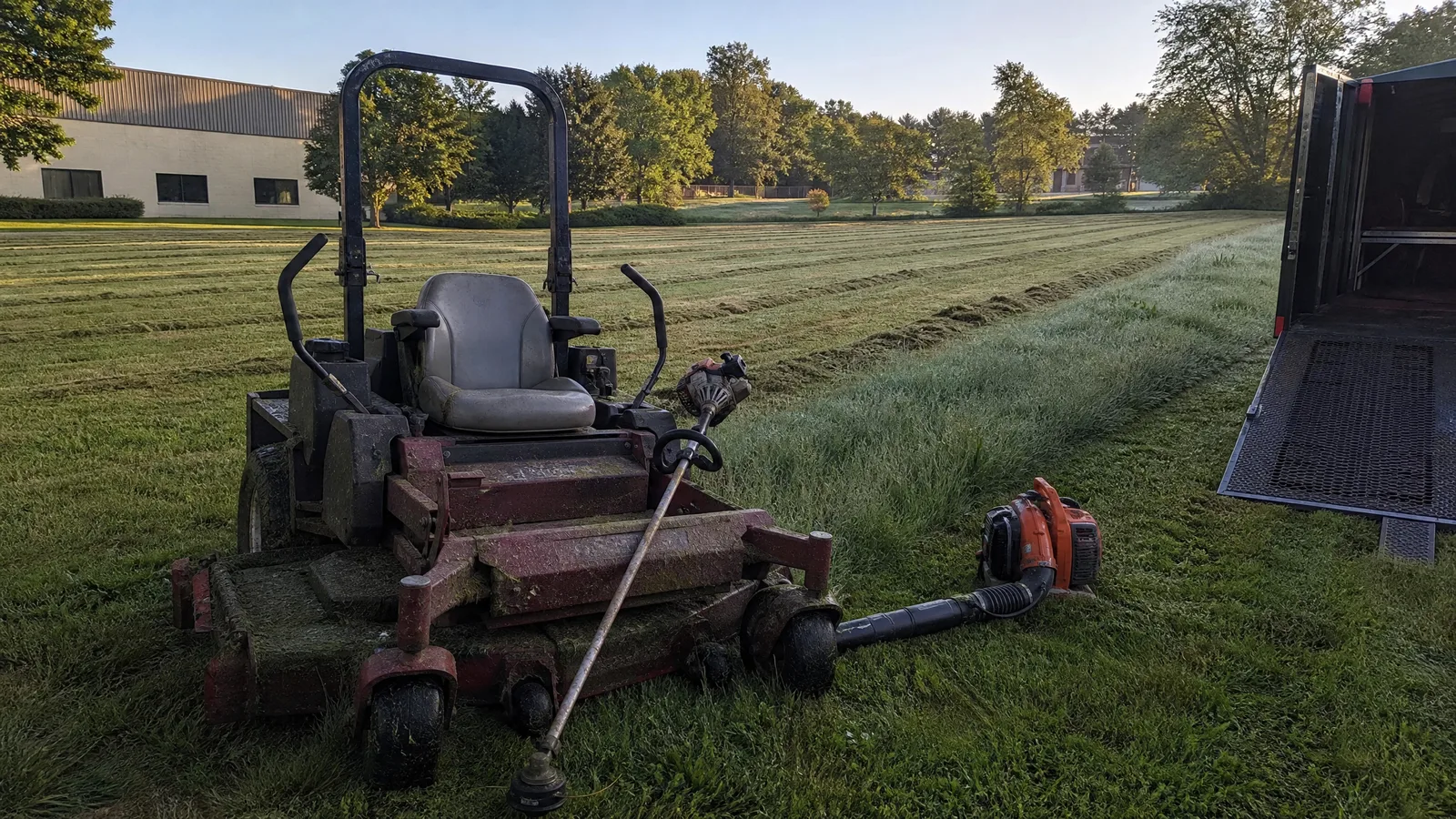
A route-based mowing operation carries a smaller version of the same set. General liability for what the mower throws and where the trimmer line goes. Coverage for the mowers and the trailer, which are the business. Commercial auto for the truck pulling that trailer through forty stops a week. Workers compensation for the second person on the crew. The line that surprises lawn care owners is the applicator one: the first weed-and-feed application sold as a service is, in Texas, an application of a pesticide for hire, and TDA's licensing sentence does not carve out general-use products. A crew that keeps chemicals on the truck also picks up the federal hazard communication rule, which applies to any employer whose workers may be exposed to hazardous chemicals and requires labels, safety data sheets, and training (29 CFR 1910.1200). OSHA's hazard list for the trade names pesticides and chemicals beside cuts and amputations, noise, heat stress, and motor vehicles (OSHA, Landscaping and Horticultural Services: Hazards), and an underwriter reading a lawn care application is reading for the same list.
Landscaping business insurance for the equipment: mowers, trailers, and the skid steer
Business property coverage can extend to equipment and supplies, owned or leased (NAIC), and almost none of a grounds crew's property sits at an address. The mowers, the blowers, the trimmers, the skid steer, and the trailer they ride on are at a job or on the road, so agents write this line to travel, as an equipment floater or under an inland marine form, rather than as contents at the shop. Ask how the trailer and everything strapped to it is covered overnight in a lot, and whether the skid steer is scheduled by serial number or swept into a blanket limit, because the theft of a loaded trailer is the loss this trade reports. Insurance for a landscaping business is, in dollar terms, mostly this line plus the trucks.
Where the crew stops being maintenance. OSHA puts the trade's hazards under its general industry standards "if work is considered maintenance activity and construction if work is considered building activity" (OSHA, Landscaping and Horticultural Services: Standards), and lists site clearing, excavation, and rollover protective structures among the construction sections that can apply. A crew that grades, trenches for drainage, and builds retaining walls is a construction crew for the hours it does that, and an underwriter reads the hardscape share of your revenue the same way. Describe it rather than letting the application say "landscaping" and leaving the reader to guess.
Commercial auto for the crew trucks and the trailers behind them
A business that owns or leases vehicles needs commercial auto. The NAIC's advice is direct: personal auto policies may exclude business use, and commercial policies carry higher limits and can reach rented and non-owned vehicles, including an employee's own car driven on company business (NAIC). For this trade the vehicle is a truck with a trailer, and the trailer is the part people forget to describe. The dump trailer, the enclosed trailer, and the equipment trailer each belong on the schedule with what they carry, and the foreman who runs to the supply yard in his own pickup with a company trailer on the hitch is the hired and non-owned exposure in its plainest form. A crew that adds a plow to the front of the same truck in November has turned it into a different vehicle to the liability form; that is the snow plow insurance page's subject.
Workers compensation for landscaping crews: the grounds class
Nearly all states require an employer to carry workers compensation, in the NAIC's words, and the state insurance department is where to check (NAIC). The premium is built from payroll by classification. The Texas Department of Insurance describes the mechanism: each employee's payroll is assigned to a classification, the payroll in each classification is multiplied by the rate for that classification per $100 of payroll, and an experience modifier reflecting the employer's own loss history may then apply (TDI, workers compensation rate guide). Grounds work has its own class. In the New York rating board's manual, code 0042 is the gardening and grounds classification, covering employers who plant or maintain lawns, gardens, trees, shrubs, and flowers at customer locations, with grass cutting, weed control, lawn spraying, and on-grade walkway and patio work inside it, and drivers included (NYCIRB, class 0042). Tree pruning and trimming is a different class, code 0106, and a crew that does both has payroll in both; the tree service insurance page explains why that class carries the weight it does. We print the codes and the mechanism, not a rate, because the rate is filed by the rating organization and set by the carrier in each state.
The day laborer. Paying a crew member cash by the day does not make him a subcontractor. For the IRS an employee is someone who works at the control and direction of another, and the right to control is what matters, exercised or not (IRS Publication 4902). A man running your mower on your route is under your direction. Texas is the state that lets a private employer decline coverage; the Department of Insurance says workers compensation "is not required in most cases" there (TDI, employer resources), and the reporting duties and lost defenses that come with declining are on the Texas hub.
Landscaping liability insurance and the client's own plants: care, custody, or control
Liability forms commonly carry a care, custody, or control exclusion, which IRMI describes as eliminating coverage for damage to property in the insured's care, custody, or control, and courts have read the phrase two ways: physical possession of the property, or a legal duty to exercise care over it (IRMI, care, custody, or control). The bed you are replanting, the pavers you have lifted to reset, the turf you are spraying, the irrigation line you are cutting into: each is property you are working on, and whether it is "in your care" is a form-and-facts question. The Texas applicator statute draws the same line from the other direction. The proof of financial responsibility it requires "is not required to apply to damages or injury to agricultural crops, plants, or land being worked on by the applicator" (Texas Agriculture Code 76.111(d)), while the structural rule requires a policy that does reach property under the licensee's care, custody, or control. Two Texas licenses, two answers, on the same property. Ask how the form you are offered treats the client's plants and hardscape, get it in writing, and if your license requires the coverage, make sure the certificate you file shows it. The same exclusion, read for property you are cleaning, is on the cleaning business insurance page.
Snow removal is a second operation
A landscaper who plows in winter is running two businesses to an underwriter, and the liability form treats the plow truck as an auto rather than as grounds work (IRMI, The ISO Classification System and the CGL Policy). Snow work can be excluded from a landscaper's policy outright, the property manager's contract usually wants one certificate for both seasons, and the question of whether the truck's coverage can rest in summer has a real answer. All of that is on the landscaping and snow removal insurance page, with the plow-only operation on snow plow insurance.
What moves a landscaping insurance premium
What an underwriter weighs, in roughly the order they weigh it. Payroll and crew size first, because the workers compensation line is built from payroll in the grounds class and, for a crew of any size, leads the account. The work mix next: mowing and maintenance, planting, hardscape and grading, irrigation, and pesticide application are each read differently, and the hardscape share moves the crew toward construction rules and construction pricing. Whether you apply chemicals for hire, and under which license, since the license may fix the minimum policy. The trucks, trailers, and mowers on the schedule and their values. Whether you plow, which is a separate operation and is priced as one. Claims history, through the experience modifier. Your state, and whether workers compensation is elective there. The lever in your hands is description: a crew that tells the underwriter what it actually does is priced on that, and a crew that writes "landscaping" is priced on the word.
Your state's rules
Texas licenses the applicator and the irrigator, not the crew, and each applicator route carries its own insurance condition. The Texas hub carries the state's structure; other states' pages follow as their agriculture departments are read.
Or start at the overview for how the whole contractor set fits together.