
Roofing contractor insurance, priced on the height and ruled by the state
This page is about the contractor's own coverage, not a homeowner's policy or a storm claim against one. For a roofing company the set is general liability with the completed-operations tail that a roof's later failure lands in, workers compensation rated in roofing's own class and priced on the six-foot fall protection trigger, coverage for the equipment that travels, and commercial auto for the trucks. Whether a license sits on top of that depends on the state: Illinois licenses roofing contractors and writes insurance and a bond into the license, and Texas licenses no one.
Roofing general liability insurance: the job in progress and the roof after you leave
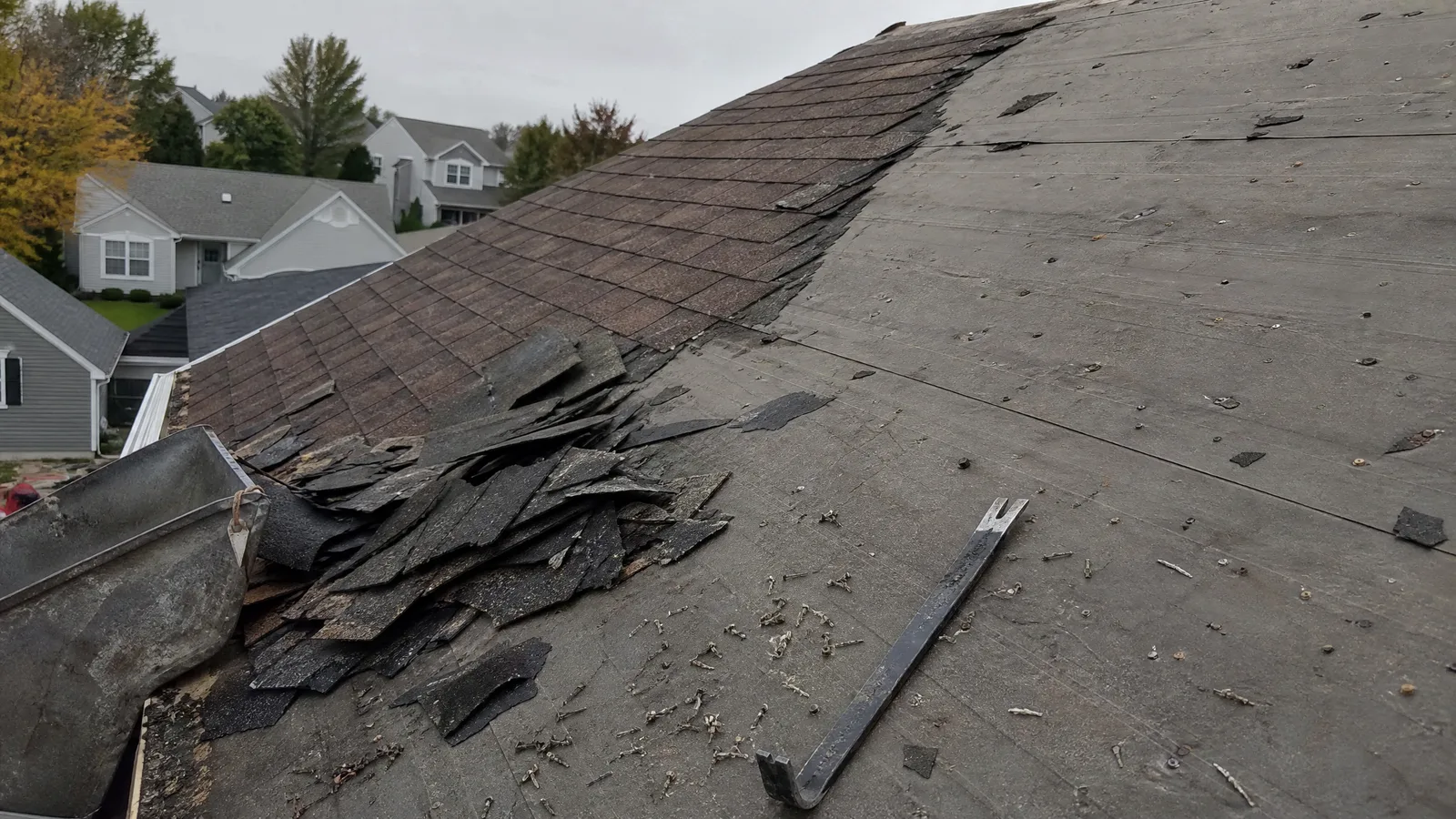
A commercial general liability policy responds to four categories of events a business can be held responsible for, in the NAIC's list: bodily injury, damage to others' property, personal injury such as slander and libel, and false or misleading advertising (NAIC, Insure U: Small Business Insurance). For a roofing crew the first two arrive in two different ways. The first is on site: a bundle of shingles that slides off the eave onto the client's car, a ladder that goes through a window, the tear-off debris that finds the neighbor's pool, the person walking under the drop zone. That is the same shape as any trade on this site. The second is the one this trade owns. A roof does not fail while the crew is there. It fails in the next hard rain, as water in the ceiling below, and by then the truck is gone and the invoice is paid. The part of the liability form that answers for damage arising from your finished work is products and completed operations, and for a roofer it is where the exposure sits. Ask how the form you are offered treats it, how long the coverage runs after the work is done, and how it separates damage to your own work from the damage your work causes to the property under it, because forms draw that line in different places.
Torch work is priced on its own. Modified bitumen applied with a roofing torch is the one part of the trade with an open flame on a building, and underwriters treat it as its own question. The roofing industry's answer is a certification: NRCA describes CERTA as "the roofing industry's certified roofing torch applicator program that establishes best practices in the design and application of torch-applied roof systems," and says plainly that the program "is a requirement for certain insurance industry underwriters as a condition for coverage" (NRCA, CERTA FAQ). A crew that torches should say so when the policy is written and should expect to be asked what its applicators hold. What the general liability form leaves out is on the NAIC's list too: professional errors and omissions. A demand that you specified the wrong membrane for the deck, or told a client a roof had years left in it, is a demand about advice, and it belongs to professional liability rather than general liability.
Insurance requirements for roofing contractors: two states, two answers
Illinois licenses the contractor and insures the license. The Illinois Roofing Industry Licensing Act makes it "unlawful for any person to engage in the business of providing professional roofing services or act in the capacity of or hold himself, herself, or itself out in any manner as a roofing contractor or a qualifying party without having been duly licensed or accepted by the Department" (225 ILCS 335, Section 9). The license comes in two classes: a limited license for contractors whose work is "limited to roofing residential properties consisting of 8 units or less," and an unlimited license for work "on residential, commercial, and industrial properties." Section 3 writes three financial conditions into the application: public liability and property damage insurance in amounts the Department determines, workers compensation covering the applicant's employees (or approval as a self-insurer), and a continuous bond "in the amount of $10,000 for a limited license and in the amount of $25,000 for an unlimited license." The insurance amounts live in the Department's rule, and the rule splits them in a way most states do not: "$250,000 for each occurrence of property damage; and $500,000 for each occurrence of personal injury or bodily harm," on a policy that cannot be cancelled without 30 days' written notice to the Division (68 Ill. Adm. Code 1460.20). The bond is not insurance; it protects the people you work for, and our bonded and insured guide separates the two. The pattern, a floor written into the contractor's license rather than into the individual tradesman's, is the same one our electrical contractor requirements guide found across eight state boards. Illinois licenses two trades at the state level, roofing and plumbing, and regulates general contracting by municipality (IDFPR, roofing contractor).
Texas licenses no one. Texas licenses named trades rather than general contracting, and the Texas Department of Licensing and Regulation's program list has no roofing, roofer, or roofing contractor entry (TDLR, licensed programs). The state's own roofing association says it more bluntly: "The Texas Department of Licensing & Regulation (TDLR) does NOT currently administer licensure for roofing contractors. Anyone can call themselves a roofer in Texas and they are not required to be knowledgeable, insured, licensed, or even registered with the state" (Roofing Contractors Association of Texas). The association runs a program it calls a license, developed "through voluntary self-regulation," with an experience condition, an exam, continuing education, and an insurance condition of its own. It is voluntary and private; it is not a Texas requirement, and its figures are the association's, not the state's. A Texas roofer is therefore in the same posture as a handyman: no board, and the person who asks for a certificate is the general contractor, the property owner, or the lender, whose contract names the limit. Some Texas cities register roofers; we have not read those ordinances and do not name one. How the state handles the rest of the trades, and the workers compensation election that matters more here than anywhere, is on the Texas contractor insurance hub. Other states fall on one side or the other of this line, so read your own board before assuming; a requirement appears here only where a rule prints one.
Roofing workers compensation insurance: the class code and the six-foot rule
Nearly all states require an employer to carry workers compensation, in the NAIC's words (NAIC), and for a roofing company it is the line that carries the account. The reason is classification. Workers compensation premium starts with payroll sorted by class, each class carrying its own rate per $100 of payroll, with an experience modifier for the employer's own loss history applied on top; that is how the Texas Department of Insurance explains its own system (TDI, workers compensation rate guide). Roofing is not carpentry payroll and it is not general contracting payroll. In the New York rating board's manual it is code 5545, roofing not otherwise classified, all operations to completion and drivers: roofing, re-roofing, roof repair, and waterproofing on roofs sloped 10 degrees or more, in shingle, metal, slate, tile, and other materials, and the class reaches the ground crew who prepare and hoist the material and run the equipment, not only the people on the deck (NYCIRB, class 5545). Other bureaus number it differently; the point is that the trade is rated on what a roofer does. No rate appears here: it is filed by the rating organization and set by the carrier in each state, and the number would be someone else's.
The hazard the class is written for. OSHA's construction fall protection standard names roofing directly. On low-slope roofs, meaning a slope of 4 in 12 or less, "each employee engaged in roofing activities ... with unprotected sides and edges 6 feet (1.8 m) or more above lower levels shall be protected from falling by guardrail systems, safety net systems, personal fall arrest systems," or one of the listed combinations of a warning line with another system (29 CFR 1926.501(b)(10)). In residential construction the trigger is the same six feet, and the choices narrow to guardrails, nets, or personal fall arrest unless another paragraph provides an alternative (1926.501(b)(13)). The systems themselves are specified in the next section, guardrails, nets, personal fall arrest, warning lines, and safety monitoring each with its own criteria, and the duty is the employer's: "provide and install" the systems the subpart requires (29 CFR 1926.502). A written fall protection program, the anchors and harnesses that back it, and the person who checks that they are worn are what an underwriter asks about before pricing this class, and they are also the law. The crew that treats the harness as optional is priced as if it were.
The day-labor crew. The trade's habit of paying a tear-off crew by the square and calling them subcontractors does not survive the IRS's test: an employee works at the control and direction of another, and the right to control is what counts, whether or not it is exercised (IRS Publication 4902). A crew that works your schedule with your nailers on the roof you sold is working under your direction, and at audit their pay is your payroll in this class. Texas lets a private employer decline coverage, and the Department of Insurance says workers compensation "is not required in most cases" (TDI, employer resources); what a non-subscriber has to file and which defenses it gives up are laid out on the Texas hub, and for a trade whose injury is a fall from a roof the election deserves an agent's hour rather than a default.
Subcontractors and the certificate: whose payroll, whose policy
Roofing runs on subcontracting in both directions. When you are the sub, the general contractor asks for a certificate of insurance before you are on the deck, usually naming the GC as additional insured, and increasingly for completed operations as well as ongoing work, so that the leak that appears after the building is occupied comes back to your policy rather than theirs. When you are the one hiring subs, the mechanism runs the other way. A workers compensation audit assigns payroll by class, and a subcontractor who cannot produce a certificate of their own coverage is, to the auditor, payroll of yours; the crew you thought you had contracted out gets rated in your class at year end. The certificate you collect from every sub is not paperwork. It is the document that keeps their payroll off your audit and their fall off your loss run. Read the general contractor's insurance clause before you price the job, since the limit it names is what your certificate has to show, and we do not print a typical one because none is published.
Roofing business insurance for the trucks and the equipment
Commercial auto. A business that owns or leases vehicles needs commercial auto; personal policies may exclude business use, and commercial forms can reach employees' own vehicles driven on company business, which is the crew lead sent to the supply house in his own pickup (NAIC). The dump trailer, the material trailer, and the truck that pulls them each belong on the schedule with their actual use described.
Property that travels. Business property coverage can extend to equipment and supplies whether owned or leased (NAIC), and a roofer's property is rarely at the shop: compressors, nailers, the tear-off equipment, ladders, and the material staged on a job overnight are on a trailer or a roof. Agents write this line as an equipment floater, often under the inland marine heading, rather than as property at a fixed address; ask how a nailer stolen from the truck bed and material stolen from a staged job are each treated. The adhesives, primers, and solvents on the truck make you an employer under OSHA's hazard communication standard, which requires labels, safety data sheets, and training for exposed workers (OSHA, Hazard Communication). The same equipment-and-crew shape, without the license question, is on the tree service insurance page, where a class code of its own carries the account for the same reason.
The roof you are standing on. Liability forms commonly carry a care, custody, or control exclusion, which removes coverage for damage to property in the insured's care, custody, or control, and courts have read that phrase two ways, as physical possession or as a legal duty to look after the property (IRMI, care, custody, or control). The deck you have opened and the structure under it are the client's property and, arguably, in your care until the roof is dried in. Ask how the form treats it before the first tear-off. On a new build the property answer is a different policy altogether: the structure and the material staged on it are insured, if at all, under the project's builders risk policy, and whether your company is named on it is worth reading before the membrane arrives.
What moves a roofing contractor insurance premium
The inputs, not a price. Payroll and crew size lead, because the workers compensation line is built on payroll in this class and carries the account. Then the work mix: residential shingle, commercial low-slope, metal, tile, and torch-applied membrane each read differently to an underwriter, and torch work is conditioned on its own. Whether you self-perform or subcontract, and whether every sub can produce a certificate. A written fall protection program and the equipment behind it. The vehicles and equipment on the schedule and what they are worth. Loss history, which reaches the workers compensation premium directly through the experience modifier. Your state, its license conditions if any, and whether workers compensation is elective there. Every roofer is quoted against the class's worst day until the file says otherwise. What makes it say otherwise is the work mix, the fall protection program, and a subcontractor file that is current.
Your state's rules
No board in Texas, and an elective workers compensation system with real trade-offs for a crew that declines it. The Texas hub carries the state's structure; roofing pages for Illinois and other licensing states follow as their rules are read.
Or start at the overview for how the whole contractor set fits together.