
Painting contractor insurance, for what leaves the wall
A paint job damages things two ways: the coating lands where it should not, and the dust from the prep goes where it should not. General liability answers for the overspray on the neighbor's cars and the stain on the client's floor, and carries an exclusion that can reach the surface you were hired to coat. The dust is a federal matter in older housing: EPA's lead rule certifies the firm, and OSHA's lead standard reaches the crew. California licenses the trade as C-33; Texas does not license it at all. Sprayers and ladders are property that travels, the van is commercial auto, and the first painter on payroll brings workers compensation in a class of its own.
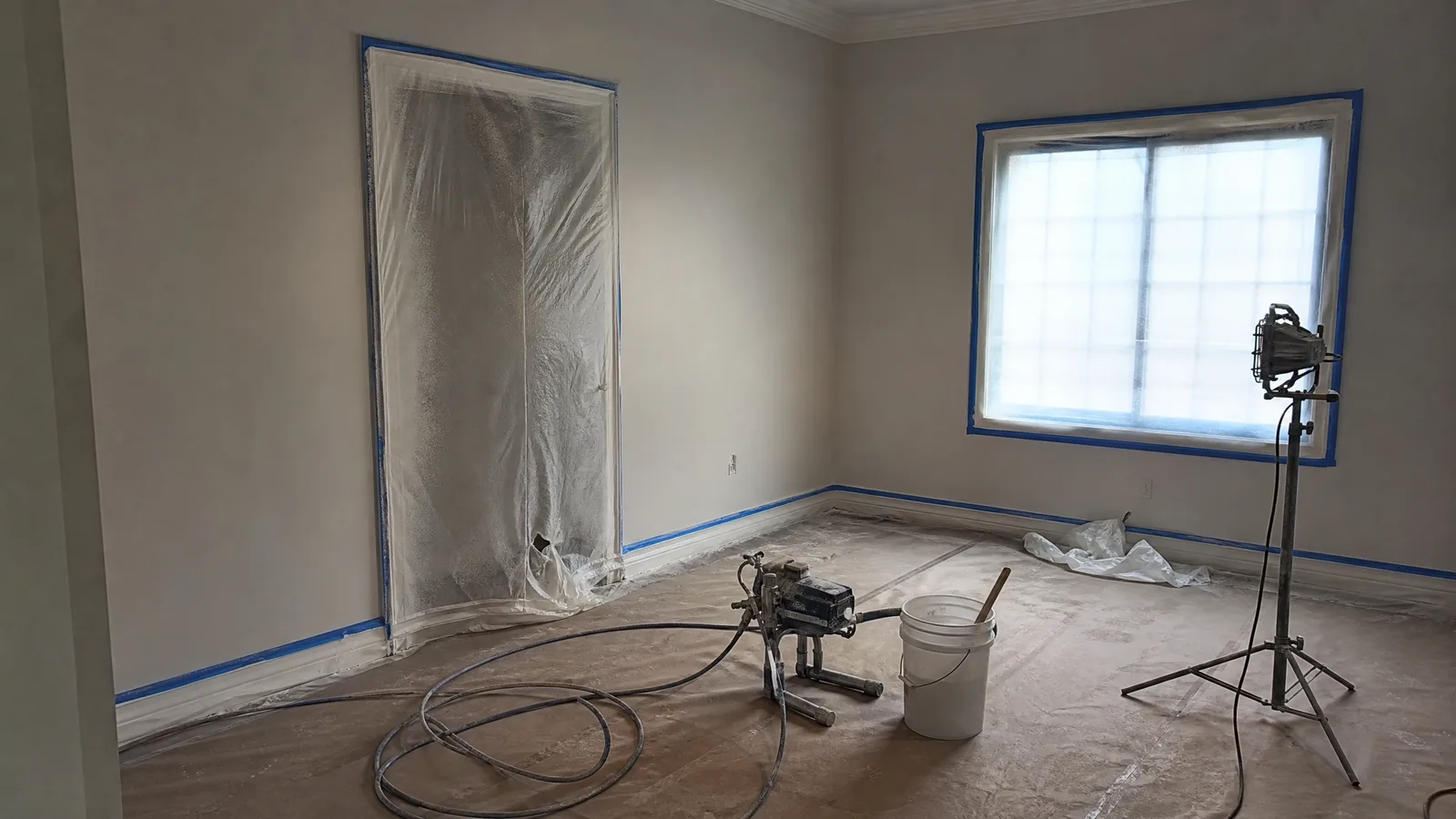
Painter's general liability: overspray, drop cloths, and the surface itself
The NAIC describes a commercial general liability policy as covering four categories of events a business can be held responsible for: bodily injury, damage to others' property, personal injury such as slander and libel, and false or misleading advertising (NAIC, Insure U: Small Business Insurance). For a painting crew the second category is the working one. Overspray from an airless rig on an exterior drifts onto the cars parked on the street and the siding next door; a can of stain goes over on a hardwood floor in a finished house; a ladder foot goes through a window. Bodily injury is the client who catches a foot in a drop cloth taped across a doorway, or the passerby under the lift on a storefront repaint. Those are the events the form was written for.
The wall you are coating is the hard case. Liability forms commonly carry a care, custody, or control exclusion, which IRMI describes as removing coverage for damage to property in the insured's care, custody, or control, and which courts have read to mean either physical possession or a legal duty to look after the property (IRMI, care, custody, or control). A cabinet door you took off its hinges to spray is plainly in your possession; whether the wall of the room you are working in is "in your care" is a form-and-facts question. Ask an agent in those words before the first job: how does this form treat the surface I am painting, and the floor under it? What the form leaves out is on the NAIC's list too: professional errors and omissions, which for a painter is the allegation that you chose the wrong primer for the substrate or the wrong system for a wet room, rather than that you spilled something. The bonded and insured guide covers the certificate a property manager asks for, and what the bond half of that phrase is and is not.
Painting contractor insurance requirements: the lead rule, and the license question
The federal rule that reaches every painter is about paint, not insurance. EPA's Renovation, Repair and Painting rule applies to "anyone paid to perform work that disturbs painted surfaces in homes, childcare facilities and preschools built before 1978." Firms doing that work must be "EPA- or state-certified and must use certified renovators who follow specific work practices to prevent lead contamination," and workers must be "certified and trained in the use of lead-safe work practices" (EPA, Renovation, Repair and Painting Program; EPA, RRP Program Rules). The rule's definitions are written for exactly this trade. A renovation is "the modification of any existing structure, or portion thereof, that results in the disturbance of painted surfaces," and the work that does not count is minor repair and maintenance that disrupts "6 square feet or less of painted surface per room for interior activities or 20 square feet or less of painted surface for exterior activities," and does not involve window replacement or demolition of painted surfaces (40 CFR 745.83). Scraping and sanding a room before a repaint is a renovation by that definition. The requirements fall away only where a certified inspector, a certified renovator using an EPA-recognized test kit, or a laboratory has found the components free of lead-based paint (40 CFR 745.82). An underwriter writing a residential repaint book will ask whether the firm holds the certification, because the rule turns on the age of the house and not on what the painter believed was on the wall.
OSHA's lead standard reaches the crew. 29 CFR 1926.62 applies "to all construction work where an employee may be occupationally exposed to lead," including "alteration, repair, or renovation of structures, substrates, or portions thereof, that contain lead." It sets an action level of 30 micrograms of lead per cubic meter of air and a permissible exposure limit of 50, both as eight-hour averages, and it begins with a duty: "Each employer who has a workplace or operation covered by this standard shall initially determine if any employee may be exposed to lead at or above the action level" (29 CFR 1926.62; OSHA, Lead). Respirators attach above the PEL and medical surveillance attaches to workers at or above the action level for more than 30 days in a year. The standard is written to employers and turns on exposure, not on the year the house was built; a solo painter is outside it, and a crew sanding an unknown coating is inside its first duty. Whether lead dust is a "pollutant" under a liability form's pollution exclusion is a wording question, and the pollution liability page explains how broad that definition is and why courts have split on its reach.
The license is a state question. California licenses the trade as its own classification: a C-33 painting and decorating contractor "prepares by scraping, sandblasting or other means and applies" paints, papers, textures, stains, varnishes, and the rest of a long list "to the surfaces of structures and the appurtenances thereto for purposes of decorating, protecting, fireproofing and waterproofing" (CSLB, Licensing Classifications), and since January 1, 2025 the license is required on any project whose total price, labor and materials, reaches $1,000 (CSLB, AB 2622 implementation bulletin). The flooring, tile, and drywall trades each hold their own California classification the same way. Texas is the other answer: the Department of Licensing and Regulation's program list, read in full, has no painting entry, and Texas licenses named trades rather than construction work generally (TDLR, licensed programs); how the state handles the trades it does license is on the Texas contractor insurance hub. Between those two sits the grey zone the handyman insurance page maps state by state, and one state in it writes coverage into the paperwork: New Jersey requires home improvement contractors to register, and registration requires proof of commercial general liability insurance of at least $500,000 per occurrence (NJ Division of Consumer Affairs, HIC registration).
Sprayers, scaffold, and the solvents on the truck
Business property coverage can extend to equipment and supplies, owned or leased (NAIC), and a painting company's property is rarely at its own address. The airless rigs, the extension ladders and pick planks, the scaffold frames, the lift you rented for the week, and a job's worth of coating staged in a client's garage are all at the job or in the van. Agents write this as an equipment floater rather than as property at a location; ask how a sprayer stolen from the van overnight is treated, and whether the rented lift is covered by you or by the rental yard.
The coatings make you an employer under OSHA. Solvents, oil-based primers, lacquers, strippers, and the two-part products in a commercial book are hazardous chemicals, and OSHA's hazard communication standard requires "all employers to provide information to their employees about the hazardous chemicals to which they are exposed," through labels, safety data sheets, and training at initial assignment and whenever a new hazard is introduced (29 CFR 1910.1200; OSHA, Hazard Communication). The general PPE standard makes the employer assess the hazards, select the equipment, and see that it fits (29 CFR 1910.132). Both rules say nothing to a solo painter and become underwriting questions the day there is a crew.
Commercial auto for the van and the ladder rack
A business that owns or leases vehicles needs commercial auto; personal policies may exclude business-related liability, and commercial forms can reach rented and non-owned vehicles, including employees' own cars driven on company business (NAIC). A painter's van is a rolling shop with a ladder rack on top, and a 28-foot extension ladder over the cab changes how the vehicle is rated and how it handles. The painter who drives their own car to the job with a five-gallon bucket in the trunk is driving for you; hired and non-owned auto liability is the line that answers for that car, and a one-van company still has the exposure.
Workers compensation for a painting crew
Nearly all states require an employer to carry workers compensation, in the NAIC's words (NAIC), and the premium is built on payroll: each employee's payroll is assigned to a classification, multiplied by a rate per $100 of payroll for that class, and adjusted by an experience modifier for the employer's own loss history, in the Texas Department of Insurance's description of the system (TDI, workers compensation rate guide). Painting is its own class. New York's rating bureau gives code 5474 the phraseology "Painting or Decorating – NOC – All Operations to Completion & Drivers" and describes it as interior and exterior painting of commercial and residential structures, and of metal tanks, fire escapes, staircases, and balconies, "using ladders, scaffolds or platforms" according to the height of the work (NYCIRB, class 5474). That is New York's code; the bureau in your state has its own, and sets its own rate. The description explains the underwriter's questions, which are about height: the share of exterior work, the stories, and whether the crew is on ladders, scaffold, or lifts. The roofing contractor insurance page is where the same height question has a federal rule attached to it.
The painter paid by the day. Whether that person is an employee turns on the right to control the work: for the IRS, an employee "works at the control and direction of another," and the right to control counts whether or not it is exercised (IRS Publication 4902). A painter on your schedule, with your sprayer, at your client's house, is working under your direction. Texas lets a private employer decline coverage, where the Department of Insurance says workers compensation "is not required in most cases" (TDI, employer resources); the filing a non-subscriber makes and the three defenses it gives up are on the Texas hub.
The coating that fails after you are paid
Under a general liability policy, completed operations "refers to work of the insured that has been completed as called for in a contract ... or work that has been put to its intended use," in IRMI's definition (IRMI, completed operations), and claims arising from completed work draw on their own aggregate limit, separate from the general aggregate (IRMI, products-completed operations). For a painter the completed-operations claim is an exterior system that peels in the second season and takes the trim with it, or a floor coating that lifts under a forklift. The form treats damage to the coating itself differently from damage the failed coating causes to other property, and that line is the one to ask about. The tile contractor insurance page is where this claim takes its sharpest form, with water instead of paint.
Painting contractor insurance cost: what moves the premium
What decides a painting premium, rather than the premium. Interior versus exterior, and on exterior work the heights, since a two-story colonial and a six-story elevator building are different books. Spray versus brush and roller, because overspray is a property claim waiting on the wind. The share of pre-1978 housing in your work and whether the firm holds the lead certification. Revenue, because liability premium is often rated on it, and payroll, because workers compensation premium is built on it, class by class. The vans on the schedule and what the sprayers in them are worth. Loss history, which reaches the workers compensation premium through the experience modifier and the liability premium through the file. Your state, and whether workers compensation is elective there. An underwriter handed the word "painting" prices the tallest wall it could mean. Give them the heights you actually work at, whether you spray or roll, and the age of the housing stock, and the quote comes back against your operation.
Your state's rules
No state license in Texas, a federal lead rule that applies everywhere, and an elective workers compensation system with real trade-offs. The Texas hub carries the state's structure; painting pages for other states follow as their rules are read.
Or start at the overview for how the whole contractor set fits together.