
Excavation contractor insurance, for what is in the hole and under it
An excavation contractor's exposure is the open ground: the worker in the trench when a wall lets go, the foundation next to the cut, and the line the bucket finds. General liability answers for the injury and the damage, with a pollution exclusion that matters when the line carried gas or fuel. Texas does not license the trade; what reaches it is OSHA's excavation standard, written to employers, and the state's 811 statute, written to anyone who digs 16 inches with a machine. The excavator, the dozer, and the trench box are the company's capital, insured on a floater. The lowboy is commercial auto. The first operator on payroll brings workers compensation.
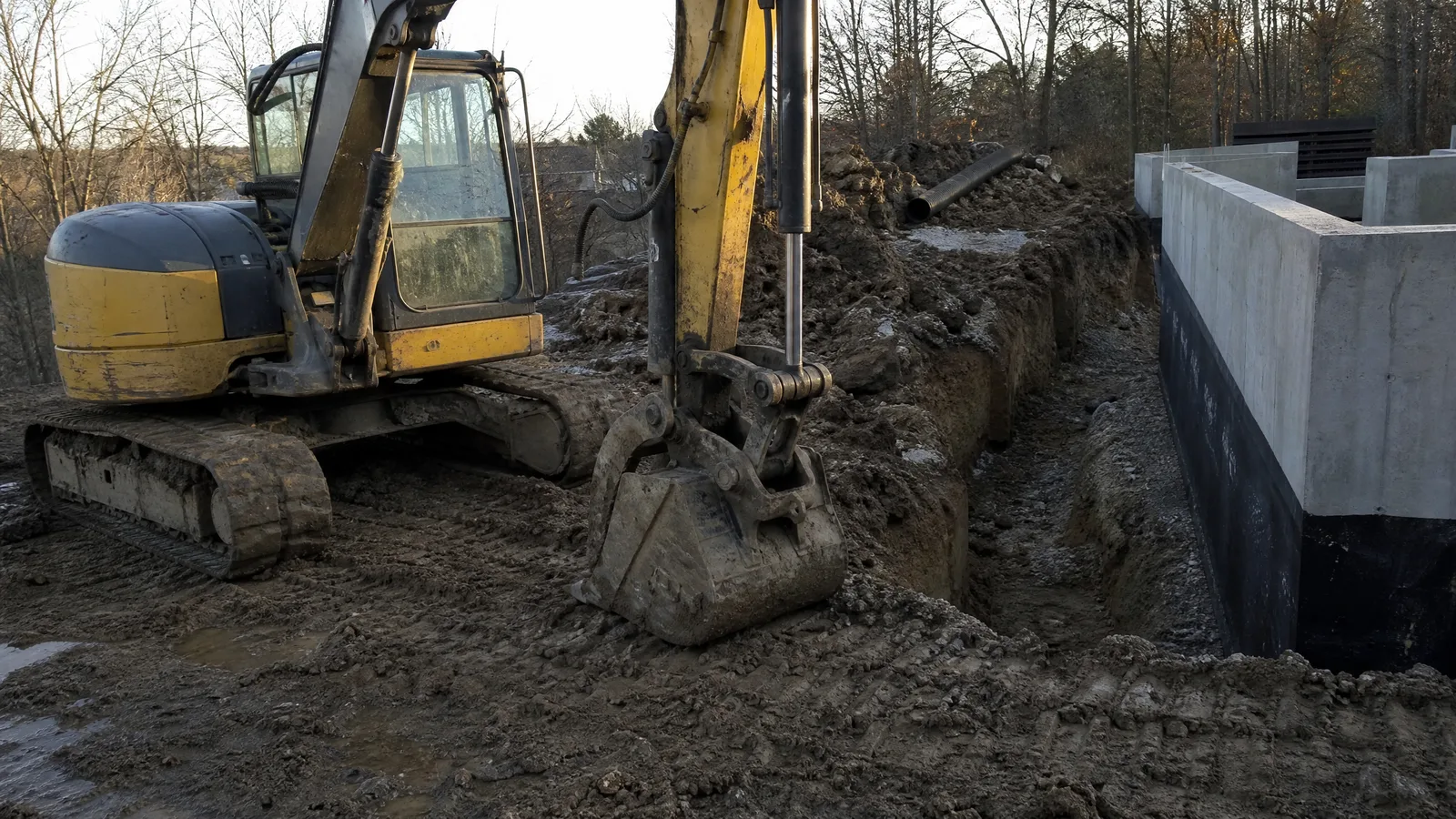
General liability for excavation: the person, the structure, the line
A general liability policy, in the NAIC's description, responds when a business is held responsible for bodily injury, for damage to other people's property, for personal injury such as libel, or for false advertising (NAIC, Insure U: Small Business Insurance). Read that list at the edge of an open excavation. Bodily injury is the customer's employee who walks the site after hours and goes into the cut, the delivery driver struck by the swing of the bucket, the neighbor's child in the unfenced hole. Property damage to others is the foundation that settles when the trench beside it is left open through a rain, the driveway the tracks broke, the irrigation main the teeth found, the fiber the ripper cut. Every one of those is the form's ordinary business.
What the form does not answer. Two things. The first is professional error: the NAIC lists errors and omissions among the risks a general liability policy does not protect against, and for this trade that is the allegation that the grade was set wrong or the compaction was not to spec, rather than that the machine hit something. The second is pollution. The standard general liability form since 1986 carries what the industry calls the absolute pollution exclusion, and the form's definition of a pollutant reaches "any solid, liquid, gaseous or thermal irritant or contaminant," which is broad enough to reach a gas line, a fuel line, or a sewer force main opened by a bucket (IRMI, absolute pollution exclusion). Courts split on how far that exclusion goes, and the honest answer for a company that digs near those lines is a contractors pollution liability policy, which the pollution liability page explains, written for exactly the gap the exclusion opens. The utility contractor insurance page follows a strike through to the outage and the fire; this page follows the hole.
OSHA's excavation standard, read in the rule
OSHA's trenching page puts the hazard in one sentence: "Trench collapses, or cave-ins, pose the greatest risk to workers' lives," and names the three answers, which are to slope or bench the walls, shore them, or shield them (OSHA, Trenching and Excavation). The rule behind the page is Subpart P of the construction standards, three sections long. The definitions come first. An excavation is "any man-made cut, cavity, trench, or depression in an earth surface, formed by earth removal." A trench is an excavation deeper than it is wide, with the width at the bottom "not greater than 15 feet." A cave-in is the separation of a mass of soil or rock from the side of an excavation, or the loss of soil from under a shield or support, "in sufficient quantity so that it could entrap, bury, or otherwise injure and immobilize a person." And a competent person is "one who is capable of identifying existing and predictable hazards in the surroundings, or working conditions which are unsanitary, hazardous, or dangerous to employees, and who has authorization to take prompt corrective measures to eliminate them" (29 CFR 1926.650(b)). That last definition is the one an underwriter cares about, because the rest of the standard runs through that person.
The protective system rule, with both of its conditions. "Each employee in an excavation shall be protected from cave-ins by an adequate protective system," except when the excavation is "made entirely in stable rock," or when it is "less than 5 feet (1.52 m) in depth and examination of the ground by a competent person provides no indication of a potential cave-in" (29 CFR 1926.652(a)(1)). The trade's shorthand is "the 5-foot rule," and the shorthand drops half the rule: under 5 feet, the duty lifts only when a competent person has examined the ground and found nothing. The sloping and benching configurations, and the support, shield, and other systems, are selected and constructed by the employer under one of four options in the standard, ending with a registered professional engineer's design (1926.652(b), (c)).
The duties around the hole. Before opening it, "The estimated location of utility installations, such as sewer, telephone, fuel, electric, water lines, or any other underground installations that reasonably may be expected to be encountered during excavation work, shall be determined," the utility owners are contacted and asked to locate, and "When excavation operations approach the estimated location of underground installations, the exact location of the installations shall be determined by safe and acceptable means." A trench 4 feet or deeper needs a ladder, ramp, or stairway within 25 feet of lateral travel for every worker in it. "No employee shall be permitted underneath loads handled by lifting or digging equipment." Nobody works in accumulating water without precautions. Spoil and equipment that could roll in stay "at least 2 feet (.61 m) from the edge." And a competent person makes "Daily inspections of excavations, the adjacent areas, and protective systems" before work starts, as needed through the shift, and after every rainstorm (29 CFR 1926.651(b), (c)(2), (e), (h)(1), (j)(2), (k)(1)). All of it is written to employers, which is why a solo operator with a mini excavator and no crew is outside the rule and a two-man company is inside it. The liability underwriter's questions about your company are this section in another order: who is your competent person, what systems do you own, how deep do you go, and how do you locate.
Excavation contractor insurance requirements: Texas 811, and California's license
Texas issues no license for excavation. The state licenses named trades through the Department of Licensing and Regulation and its boards, and earthwork is not among them (TDLR, licensed programs); the Texas contractor insurance hub has the state's structure. What Texas does have is a statute that names this trade's work. The Utilities Code defines excavating as using "explosives or a motor, engine, hydraulic or pneumatically powered tool, or other mechanized equipment of any kind," including boring, digging, ditching, grading, ripping, scraping, trenching, and tunneling, "to remove or otherwise disturb soil to a depth of 16 or more inches." Before beginning, the excavator notifies a notification center "not earlier than the 14th day before the date the excavation is to begin or later than the 48th hour before the time the excavation is to begin, excluding Saturdays, Sundays, and legal holidays," which the trade calls two business days. The notice names the site, the company, the start date and time, and whether explosives will be used. Emergencies that endanger life, health, or property may begin at once with notice as soon as practicable, and agricultural work on private property is among the listed exceptions. If the bucket finds a line, the excavator "shall immediately contact the underground facility operator to report the damage," only the operator may repair it, backfilling in the area waits until a repair schedule is agreed, and where flammable material is present the excavator "shall keep sources of ignition away." An excavator that skips the notice or the damage duties "is liable for a civil penalty of not less than $500 or more than $1,000," with higher ranges for repeat violations in a year (Tex. Util. Code §§ 251.002, 251.151, 251.152, 251.155, 251.156, 251.159, 251.201). The penalty is the statute's; the repair, the outage, and the injury are the claim.
California licenses it. The Contractors State License Board's C-12 classification, Earthwork and Paving Contractors, is described in the Board's regulation as a contractor who "digs, moves, and places material forming the surface of the earth, other than water, in such a manner that a cut, fill, excavation, grade, trench, backfill, or tunnel (if incidental thereto) can be executed, including the use of explosives for these purposes" (CSLB, C-12 Earthwork and Paving). Every CSLB licensee posts a $25,000 contractor's bond, and licensees organized as LLCs carry liability insurance as a license condition (CSLB, Bond Requirements; CSLB, LLC licenses). Two states, read as two states.
Equipment: the excavator, the dozer, and the trench box
In this trade the equipment is the company. An excavator, a dozer, a compactor, a skid steer, and a set of trench boxes are worth more than everything else the business owns put together, and none of it is at the office. The NAIC's description of business property coverage reaches machinery and equipment, owned or leased (NAIC), but property at a fixed address is the wrong shape for iron that lives on job sites, so agents write it on an equipment floater, "Property insurance covering equipment that is often moved from place to place," in IRMI's definition, "a form of inland marine insurance" (IRMI, equipment floater). The builders risk policy on the project is written on the same inland marine family of forms, which is a useful way to understand both: they follow the property, not the address. The schedule should list each machine with its value and say what happens to a machine stolen off a site over a weekend, rolled on a slope, or flooded in a hole it was parked beside.
The machine's two lives. IRMI's mobile equipment entry is the map. Earth movers and diggers, "even when self-propelled, are not considered automobiles for insurance purposes (unless they are subject to a compulsory or financial responsibility law or other motor vehicle insurance law)"; "Liability arising from mobile equipment is covered in the general liability policy. Physical damage coverage is usually provided by an 'equipment floater'" (IRMI, mobile equipment). So the excavator that swings into a parked car is a general liability claim, and the same excavator stolen is a floater claim. The trench box has a third life: it is a shield system under the standard, and an underwriter who asks how many you own and whether you rent more for deep work is asking a liability question about a piece of property. Rented boxes and rented machines go on the floater described as rented, because the rental agreement puts them in your care.
Commercial auto for the lowboy and the dump
The trucks are a separate policy. A business that owns or leases vehicles needs commercial auto; personal forms may exclude business use, and commercial forms can reach hired and non-owned vehicles, including an employee's own truck on company business (NAIC). For an excavation company that means the lowboy and the tractor that pulls it, the dump trucks, the service truck, and the pickups, each on the schedule with its use described, because a tractor hauling a 40,000-pound machine is a different risk from the same tractor empty. A dump truck is an auto by any reading; a dozer is not; a machine driven on a public road under a registration is the one to name to an agent. The operator who drives his own truck to the site is on company business, and hired and non-owned liability is the line for him.
Workers compensation for an excavation crew
Employers in nearly every state must carry workers compensation, in the NAIC's phrasing (NAIC). Premium is payroll sorted into classes, each class times a rate per $100 of payroll, adjusted by an experience modifier for the company's own losses; that is Texas's description of the mechanism its rating system uses (TDI, workers compensation rate guide). Which class is the bureau's decision and differs by state. New York's rating board publishes its phraseology, and its excavation class is Code 6217, "Excavation – NOC – All Operations to Completion & Drivers," which "applies to employers engaged in general excavation including ditch digging, burrowing, filling or backfilling," with earth and rock removed "by power shovels, trench diggers or bulldozers" and piled on site for backfill; sub-surface grading for roads and mass rock excavation are referred to other codes (NYCIRB, Class 6217). No rate is printed here. The phraseology is the point: "NOC" means not otherwise classified, and a company that digs road sub-base or blasts rock may belong in a different class from one that digs basements, which is why the description of your work is the first thing the underwriter reads.
The operator paid by the day. An employee, for the IRS, is someone who "works at the control and direction of another," and the right to control counts whether or not it is used (IRS Publication 4902). An operator in your seat on your site is under your direction. Texas lets a private employer decline coverage; the Department of Insurance says workers compensation "is not required in most cases" (TDI, employer resources), and the Texas hub has what a non-subscriber files and the defenses it loses. For a trade whose defining injury is a cave-in, that election deserves more thought than most.
Excavation contractor insurance cost: what moves the premium
Factors and no figures. Depth first, because the standard changes at 4 feet and 5 feet and an underwriter's view of the company changes with it. Soil, since stable rock and wet clay are different excavations under the same rule. How close you work to occupied structures and to buried utilities, and how you locate. Whether the book is basements and footings, site grading, or utility trenching, which the class phraseology separates. The iron on the floater and what it would cost to replace. Payroll by class and revenue. Whether you own protective systems or rent them per job. Loss history, which reaches the workers compensation premium through the modifier and the liability premium through the file. Your state, and whether workers compensation is elective there. The tree service insurance page is the trade that clears the site before you arrive, and landscaping insurance the one that grades it after you leave; both share the equipment problem and neither shares the trench.
Your state's rules
No state license, a federal excavation standard written to employers, an 811 statute written to anyone with a machine, and an elective workers compensation system. The Texas hub carries the state's structure; the concrete and paving pages carry the trades that follow the excavator onto the site, and the electrical contractor page the licensed trade whose conduit you are trenching for.
Or start at the overview for how the whole contractor set fits together.