
Concrete contractor insurance, for the slab after you leave
A concrete contractor's two exposures are dust while the crew is on site and cracks after it has gone. General liability answers for the person hurt at the pour and the property damaged around it, and carries an exclusion for damage to your own completed work that decides whether the heaved driveway is a claim. The federal silica standard reaches every employer whose crew cuts, cores, or chips concrete. The forms, the saws, and the pump are property that travels, insured on a floater; the truck is commercial auto; and the first finisher on payroll brings workers compensation, priced by a class the rating bureau names.
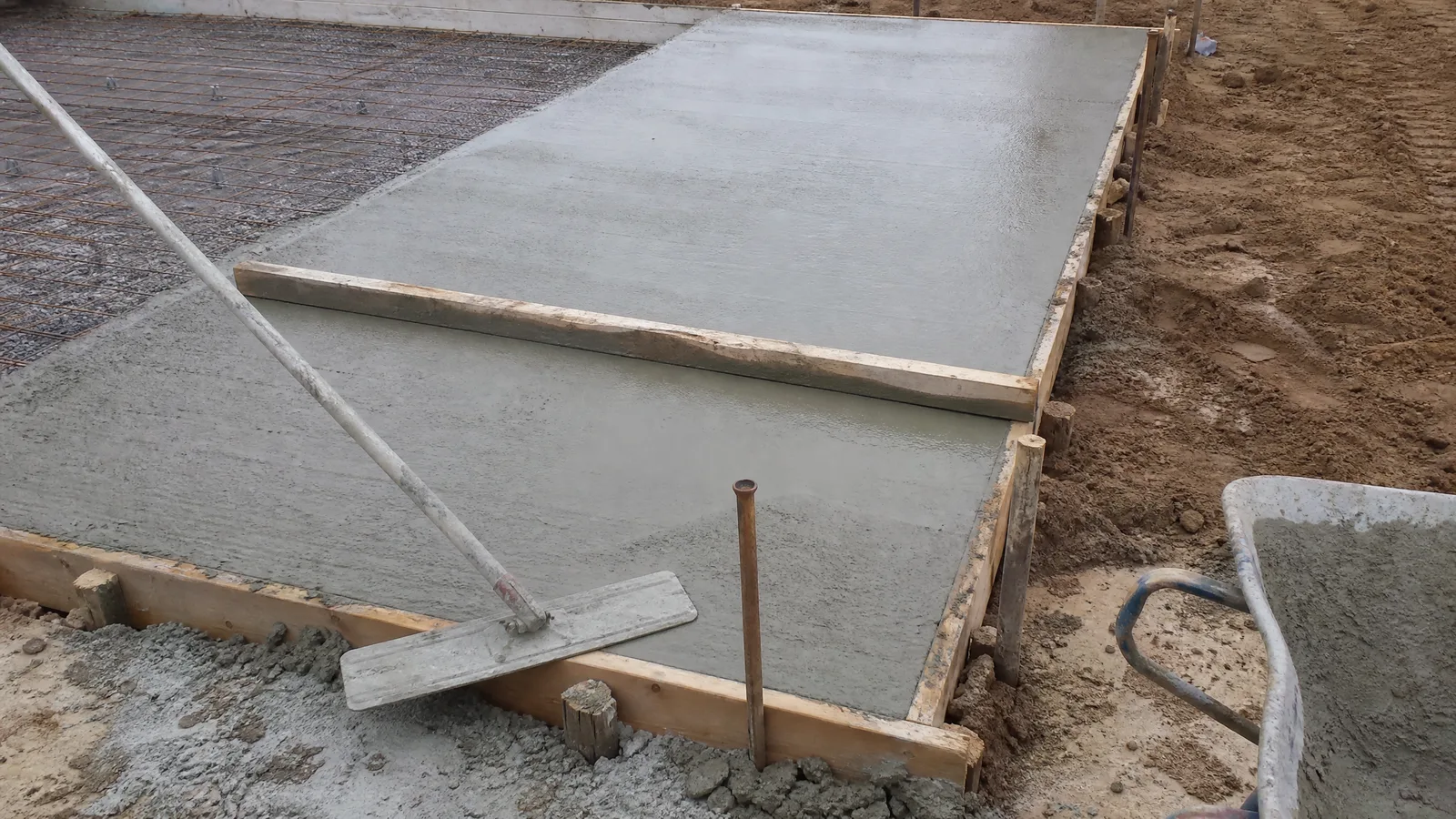
General liability for concrete work, and the completed-operations claim
The NAIC describes a commercial general liability policy as covering four kinds of event a business can be held responsible for: bodily injury, damage to other people's property, personal injury in the slander and libel sense, and false advertising (NAIC, Insure U: Small Business Insurance). On a pour day the first two are the whole story. Bodily injury is the homeowner who steps off the porch onto a fresh walk and into a rebar mat, or the passerby who walks into a form stake. Property damage to others is the neighbor's driveway the mixer chute dripped across, the sprinkler line the skid steer caught, the overspray of curing compound on a parked car. Those are the claims the form was written for, and it answers them without much argument.
The slab after cure is the hard case. Damage that appears after the crew has left sits in a separate part of the policy. IRMI defines the products-completed operations hazard as liability arising out of the insured's products or "business operations conducted away from the insured's premises once those operations have been completed or abandoned," and claims inside it draw on their own aggregate limit (IRMI, products-completed operations). Inside that hazard the standard form carries an exclusion for damage to your own work. IRMI's glossary records the exception that matters most to this trade: the subcontractor exception "restores coverage when the damaged work, or the work causing the damage, was performed by the named insured's subcontractor," and IRMI notes that insurers may remove the exception by endorsement (IRMI, subcontractor exception). Read that as a contractor. A driveway that heaves in the first winter, a warehouse floor that curls at the joints, a foundation wall that spalls: each is a completed-operations claim, and whether the damage to the concrete itself is covered turns on who poured it, whether the exception survived the endorsements, and how the carrier reads the loss. There is no rule to print. There is a question to ask an agent before the first job: how does this form treat damage to my own completed work, and is the subcontractor exception still in it? What the form leaves out entirely is on the NAIC's list: professional errors and omissions, which here is the allegation that the mix design or the joint spacing was wrong rather than that the crew hit something.
The silica rule: the federal requirement that reaches every concrete crew
Texas does not license concrete contractors, and where a state does license the trade the condition is usually a bond rather than a liability policy. What reaches this trade everywhere is OSHA's construction silica standard, and it reaches the tools on the trailer. The standard "applies to all occupational exposures to respirable crystalline silica in construction work, except where employee exposure will remain below 25 micrograms per cubic meter of air (25 μg/m3) as an 8-hour time-weighted average (TWA) under any foreseeable conditions," and the employer "shall ensure that no employee is exposed to an airborne concentration of respirable crystalline silica in excess of 50 μg/m3, calculated as an 8-hour TWA" (29 CFR 1926.1153(a), (d)(1)). Cutting, coring, grinding, and chipping cured concrete are how a finisher's crew meets that threshold.
Table 1 is the practical rule. For the tasks it lists, the employer either implements the table's engineering controls, work practices, and respiratory protection in full, or measures exposure and controls it another way. For handheld power saws of any blade diameter, and for walk-behind saws, the control is to "Use saw equipped with integrated water delivery system that continuously feeds water to the blade"; outdoors the walk-behind saw needs no respirator, the handheld saw needs one after four hours in a shift, and either saw indoors or in an enclosed area needs one for any duration. For jackhammers and handheld chipping tools, the control is to "Use tool with water delivery system that supplies a continuous stream or spray of water at the point of impact," or a shroud with a dust collector whose filter is 99 percent or better (29 CFR 1926.1153, Table 1; OSHA, Silica, Crystalline: Construction). The standard also has its own competent person, "an individual who is capable of identifying existing and foreseeable respirable crystalline silica hazards in the workplace and who has authorization to take prompt corrective measures to eliminate or minimize them." The rule is written to employers about employees; it says nothing to a one-person finishing outfit and everything to a crew. An underwriter who asks whether your saws are wet-cut is asking whether your company is inside this rule, and the answer shapes the workers compensation file more than any other single fact about the operation.
Concrete contractor insurance requirements: Texas and California
Texas licenses named trades and not general construction work: electricians and HVAC contractors through the Department of Licensing and Regulation, plumbers through their own board, and concrete work through no one (TDLR, licensed programs). There is no state license, no statutory liability minimum, and no board to file a certificate with; how the state handles the trades it does license, and how its elective workers compensation system works, is on the Texas contractor insurance hub. The electrical contractor insurance page is the contrast worth reading, because there the Texas license itself carries a liability floor. The requirement a Texas concrete contractor actually meets comes from the general contractor's subcontract or the owner's insurance specifications, and on a commercial project the property side of the job is usually a builders risk policy the construction contract puts on the owner or the general, not on the concrete sub.
California is the licensed example. The Contractors State License Board licenses the trade as C-8, Concrete Contractor, and the Board's regulation describes the classification: "A concrete contractor forms, pours, places, finishes and installs specified mass, pavement, flat and other concrete work; and places and sets screeds for pavements or flatwork" (CSLB, C-8 Concrete Contractor). The license carries a contractor's bond of $25,000 for every licensee, and a liability insurance condition only for licensees organized as LLCs, with a $1 million cumulative limit at five or fewer personnel of record (CSLB, Bond Requirements; CSLB, LLC licenses). Two states, printed as two states. Your own state's board, or the absence of one, is the first thing to check.
Equipment: forms, screeds, saws, and the pump
Business property coverage can reach equipment, machinery, and supplies, owned or leased (NAIC), but a concrete contractor's property is almost never at the address on the policy. It is on the site: the form panels and stakes, the laser screed, the power trowels, the walk-behind saw, the core rig, the vibrators, the skid steer, and, for the companies that own one, the pump. That is why agents write this line as an equipment floater, which IRMI defines as "Property insurance covering equipment that is often moved from place to place. It is a form of inland marine insurance" (IRMI, equipment floater). The schedule should say what each piece is worth and whether it is covered off the truck, on the site overnight, and in transit, because the theft that empties a job trailer over a weekend is the loss this line exists for.
Which policy answers for what the machine does. IRMI's mobile equipment entry draws the line: earth movers, diggers, forklifts, and the like, "even when self-propelled, are not considered automobiles for insurance purposes (unless they are subject to a compulsory or financial responsibility law or other motor vehicle insurance law)," and "Liability arising from mobile equipment is covered in the general liability policy. Physical damage coverage is usually provided by an 'equipment floater'" (IRMI, mobile equipment). So the skid steer that backs into a gas meter is a general liability claim, and the skid steer that is stolen is a floater claim. A truck-mounted pump is the piece to name to an agent, since it is registered and driven on the road in one role and a boom over a customer's roof in the other. Forms rented from a supplier belong on the floater too, described as rented, because the rental contract makes you responsible for them while they are in your care.
Commercial auto for the crew truck and trailer
A business that owns or leases a vehicle needs commercial auto, because personal auto policies may exclude business-related liability, and commercial forms can reach rented and non-owned vehicles, including an employee's own truck driven to a job (NAIC). For a concrete contractor the vehicle list is short and heavy: the crew truck, the trailer with the forms and the screed on it, and the skid steer trailer. The ready-mix truck that backs to the chute is the supplier's, and the supplier's driver, so it is on someone else's policy; the pump truck, if you own it, is on yours. The finisher who drives his own pickup to the site is driving for you, and hired and non-owned auto liability is the line that answers for that vehicle.
Workers compensation for a concrete crew, and the class that prices it
Nearly all states require an employer to carry workers compensation (NAIC), and the premium is built from payroll sorted into classifications, with a rate per $100 of payroll for each class and an experience modifier for the company's own loss history, which is how the Texas Department of Insurance describes the system it regulates (TDI, workers compensation rate guide). The class is the rating bureau's call and varies by state. New York's bureau, which publishes its phraseology, has a class for this trade: Code 5221, "Concrete or Cement Work – Floors, Driveways, Yards or Sidewalks – All Operations to Completion & Drivers," covering flatwork from grading and forming through pouring, troweling, and stripping. It may not be divided with the code for concrete work on bridges and culverts, and street and road work is referred to the road construction codes (NYCIRB, Class 5221). The rate is the carrier's and the state's. The point is what the phraseology tells you: a company that pours driveways and one that pours bridge decks are two different classes to the bureau, and describing your work precisely is how you land in the right one.
The finisher paid by the yard. Whether that person is an employee turns on the right to control the work, not on how the check is written: for the IRS an employee "works at the control and direction of another," and having the right to control is enough (IRS Publication 4902). A finisher on your schedule with your screed at your customer's pour is under your direction. Texas is the state where a private employer may decline coverage, and the Department of Insurance says so plainly: workers compensation "is not required in most cases" (TDI, employer resources). What a non-subscriber files and the defenses it gives up are on the Texas hub.
Concrete contractor insurance cost: what moves the premium
There is no number to print here, only what one would be built from. What you pour leads: residential flatwork, commercial slabs, foundations, structural walls, and elevated decks each read differently, and anything formed above grade or poured below it reads differently again because of what a fall or a collapse costs. Whether you cut, core, and chip, and with what dust controls, since that is the silica rule's question and the workers compensation underwriter's. Whether you pump, and whether the pump is yours. Payroll by class, because the workers compensation premium is built on it, and revenue, because the liability premium is often rated on it. The equipment on the floater and what it is worth. Whether you work as a subcontractor to a general, which shapes the completed-operations question and the certificates you are asked for. Loss history, through the experience modifier and the file. Your state, and whether workers compensation is elective there. A company described as concrete work is priced on the class's worst case; a company described by its pours, its tools, and its controls is priced on what it does. The paving contractor insurance page is the neighbor: same flatwork class in some bureaus, different material, and a pollution question this trade does not carry.
Your state's rules
No state license, a federal silica standard written to employers, and an elective workers compensation system. The Texas hub carries the state's structure; the excavation and utility contractor pages carry the trades that open the ground before the concrete goes in, and landscaping insurance the trade that finishes around it.
Or start at the overview for how the whole contractor set fits together.