
Pressure washing business insurance, for the surface you were paid to clean
A pressure washer's exposure is the client's property, and two things go wrong with it: the wand damages it, or the water it carries away ends up somewhere it should not. General liability answers for the passerby and the neighbor's car, and carries an exclusion that can reach the surface itself. No state licenses the trade, so the requirement that finds you is your city's rule on wash water, which sits under a federal definition of what may enter a storm drain. The rig and the surface cleaner are property that travels, the truck and trailer are commercial auto, and the first helper brings workers compensation.
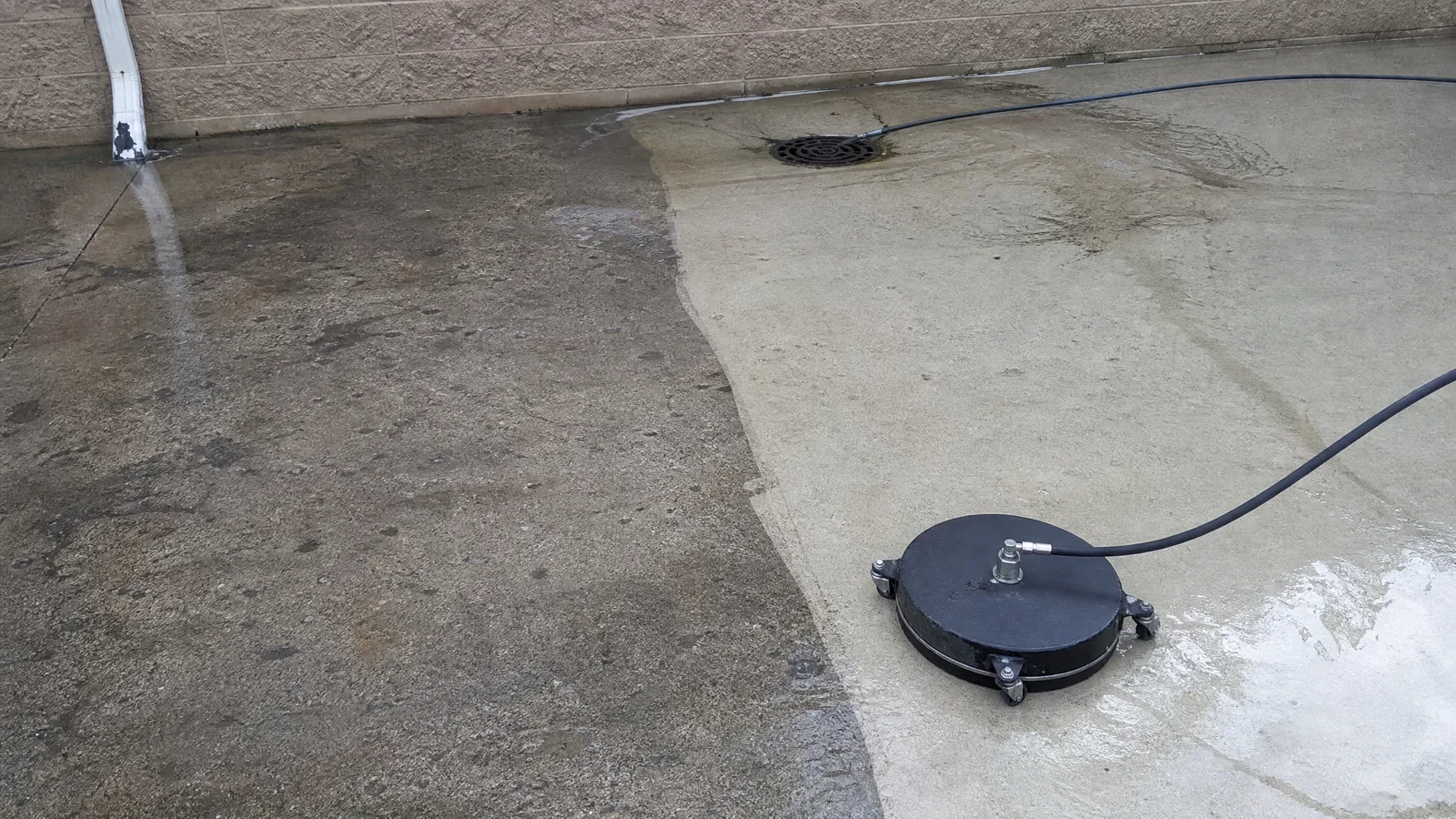
Pressure washing insurance: general liability and the surface in your care
A commercial general liability policy responds to four categories of events a business can be held responsible for, in the NAIC's list: bodily injury, damage to others' property, personal injury such as slander and libel, and false or misleading advertising (NAIC, Insure U: Small Business Insurance). The first two are a wash day. Bodily injury is the customer who walks across the wet pool deck, or the passerby under the second-story soffit you are rinsing. Property damage to others is the neighbor's car in the drift from a house wash, the landscaping burned by runoff, the mailbox the hose took down. Those are the claims the form was written for, and the ones it answers cleanly.
The surface itself is the hard case. Liability forms commonly carry a care, custody, or control exclusion, which IRMI describes as eliminating coverage for damage to property in the insured's care, custody, or control, and which courts have read to mean either physical possession or a legal duty to look after the property (IRMI, care, custody, or control). This trade's losses live near that line: glass etched by a zero-degree tip held too close, paint stripped from a door, water driven behind lap siding and into the wall, a deck board lifted and furred by the wand, the mortar washed out of a joint. Each is damage to the thing you were hired to clean, and whether that thing was in your care is a form-and-facts question that IRMI itself records courts splitting on. There is no rule to print. There is a question to ask an agent, in those words, before the first job: how does this form treat property I am working on? The cleaning business insurance page has the same exclusion with an interior damage list, and the two are worth reading together. What the form leaves out is on the NAIC's list too: professional errors and omissions, which here is the allegation that you chose the wrong chemical or the wrong pressure for the substrate rather than that you hit something.
Pressure washing insurance requirements: no license, and the storm drain rule
No state licenses pressure washing as a trade. In Texas, the Department of Licensing and Regulation's list of programs has no pressure washing, power washing, or cleaning entry (TDLR, licensed programs), and Texas licenses named trades rather than service work generally; how it handles the trades it does license is on the Texas contractor insurance hub. So there is no board, no license floor, and no statutory minimum. The requirement that reaches this trade is about where the water goes, and it is worth following from the top, because a contractor who understands the chain understands why a city inspector can stop a job over a curb inlet.
The federal definition. EPA's stormwater program regulates discharges from municipal separate storm sewer systems, construction, and industrial activity, and operators of those sources "might be required to obtain an NPDES permit before they can discharge stormwater" (EPA, NPDES Stormwater Program). A municipal separate storm sewer is the system of "roads with drainage systems, municipal streets, catch basins, curbs, gutters, ditches, man-made channels, or storm drains" a city owns, and an illicit discharge is "any discharge to a municipal separate storm sewer that is not composed entirely of storm water," with narrow exceptions for permitted discharges and firefighting (40 CFR 122.26(b)(2), (b)(8)). The city's permit application must describe "a program, including a schedule, to detect and remove" illicit discharges and improper disposal into the storm sewer (122.26(d)(2)(iv)(B)). EPA's own outreach material puts the reason in one sentence for the people it wants cities to teach: "storm drains lead directly to local waterways, not to treatment facilities," and outdoor washing "can cause detergent-rich water to flow into storm drains" (EPA, Stormwater BMP: Vehicle Maintenance and Washing, EPA-832-F-21-032F). Read that as a contractor: a surface cleaner draining to the curb is, by definition, the thing the city is required to find and stop.
The Texas layer. The rule is written to the city, not to you. TCEQ authorizes Texas cities to operate their storm sewers under a general permit for small municipal separate storm sewer systems, TXR040000, which defines an illicit discharge as "Any discharge to a municipal separate storm sewer that is not entirely composed of stormwater," with the same narrow exceptions, and lists the non-stormwater flows a city may allow in. That list includes "Individual residential vehicle washing" and "Street wash water"; it does not include commercial wash water of any kind. Where the permit does allow washing, on construction sites the city itself operates, the line is drawn at "Water from the routine external washing of vehicles, the external portion of buildings or structures, and pavement, where detergents and soaps are not used" and the purpose is to remove mud, dirt, or dust (TCEQ, TPDES General Permit TXR040000, Part I, Part II.C, Part VI.B.3; TCEQ, MS4 stormwater permits). That is the state's own answer to what plain water may do and what soap may not, and it is the shape every city ordinance below it takes.
Two cities, read as two cities. Fort Worth requires "Any person or business who engages in mobile commercial cosmetic cleaning" to hold a permit under its Cosmetic Cleaning Ordinance, and defines the activity as "power washing, steam cleaning, and any other mobile cosmetic cleaning operation, of vehicles and/or exterior surfaces, engaged in for commercial purposes." The program exists to "limit detergents and other pollutant discharges into the city's storm drain system," and the city describes three lawful places for the water: the sanitary sewer, subject to grease, grit, temperature, and pH limits; the storm drain only when the water carries no detergents, degreasers, or similar contaminants and has been screened and filtered through oil-absorbent material; or collection and containment on the property with booms and vacuums (City of Fort Worth, Mobile Commercial Cosmetic Cleaning (Power Washer) Regulation). Austin's rule is a prohibition and a haul-away: "Power washing and mobile car wash wastewater may not be discharged into the storm sewer if it contains pollutants or cleaning compounds and has not been treated before entering the environment," it may go to the sanitary sewer only if "collected and transported to a private fixed-site facility connected to the City's sanitary sewer collection system," it "may not be dumped into a cleanout, manhole or toilet at the site being cleaned" unless that site holds an Austin Water permit and a sized sand-oil interceptor, and the operator files a discharge permit application because "all industrial wastewater discharges must be authorized by permit" (City of Austin, Wastewater Disposal for Power Washers & Mobile Car Washes). Those are two cities' rules, and yours will have its own. An underwriter will ask how you recover wash water, and a property manager who asks for a certificate will often ask the same thing in the contract, alongside the "bonded and insured" line our bonded and insured guide explains.
Pressure washing equipment insurance, and the chemicals on the truck
Business property coverage can extend to equipment and supplies whether owned or leased (NAIC), and a pressure washer's property is never at an address. The skid or trailer unit, the pump and engine, the surface cleaner, the reels of hose, the water tank, the ladders, and the chemical stock are on a trailer parked at a job or outside a motel. Agents write this line as an equipment floater rather than as property at a fixed location; ask how a unit stolen off the trailer overnight is treated, and whether the trailer itself is on the auto policy or the property one, because it can end up on neither.
The chemicals make you an employer under OSHA. Sodium hypochlorite mixes, surfactants, degreasers, and the acids used on masonry are hazardous chemicals, and OSHA's hazard communication standard requires "all employers to provide information to their employees about the hazardous chemicals to which they are exposed," through labels, safety data sheets, and training at initial assignment and whenever a new hazard is introduced (29 CFR 1910.1200; OSHA, Hazard Communication). The general PPE standard makes the employer assess the workplace for hazards that require protective equipment, select it, and see that it fits (29 CFR 1910.132). Both rules are written to employers, and say nothing to a solo operator; both become underwriting questions the day a helper is on the crew. The landscaping insurance page is the contrast worth reading: same yard, same client, and there the chemical carries a state license with an insurance condition on it, which here it does not.
Commercial auto for the truck, the trailer, and the tank
A business that owns or leases vehicles needs commercial auto; personal policies may exclude business-related liability, and commercial forms can reach rented and non-owned vehicles, including employees' own vehicles driven on company business (NAIC). In this trade the vehicle is the business. A pickup pulling a trailer with a skid unit and several hundred gallons of water is a heavy, top-loaded rig that handles differently loaded than empty, and the trailer belongs on the schedule with its actual use described, not as an afterthought. The helper who meets you at the job in their own truck is driving for you; hired and non-owned auto liability is the line that answers for that vehicle, and a one-truck company still has that exposure.
Workers compensation for a pressure washing crew
Nearly all states require an employer to carry workers compensation, in the NAIC's words (NAIC). Premium starts with payroll sorted into classifications, a rate per $100 of payroll for each class, and an experience modifier for the employer's own loss history; that is the Texas Department of Insurance's description of its system (TDI, workers compensation rate guide). The class a pressure washing crew lands in is the rating organization's call and varies by state, so we print the mechanism and not a code; the questions behind the class are ladders and lifts, chemicals, and slick surfaces, which is why an underwriter asks how often the crew leaves the ground.
The helper paid by the job. Whether that person is an employee turns on the right to control the work, not on how you pay: for the IRS, an employee "works at the control and direction of another," and the right to control counts whether or not it is exercised (IRS Publication 4902). A helper on your schedule, with your rig, at your client's house, is working under your direction. Texas lets a private employer decline coverage, and the Department of Insurance says workers compensation "is not required in most cases" (TDI, employer resources); the filing a non-subscriber makes and the defenses it gives up are on the Texas hub.
Pressure washing insurance cost: what moves the premium
The inputs, not a price. The services lead. Flatwork on driveways and sidewalks, house washing, roof cleaning, fleet and equipment washing, and commercial buildings each read differently, and roof work and anything above one story read differently again because of the height and what a fall costs. Whether you apply chemicals, which ones, and at what strength, since a soft-wash mix on a roof is a different conversation from plain water on concrete. Revenue, because the liability premium is often rated on it, and payroll, because the workers compensation premium is built on it. The vehicles and trailers on the schedule and what the equipment on them is worth. How you recover and dispose of wash water, which is both a city rule and an underwriter's question. Loss history, which reaches the workers compensation premium through the experience modifier and the liability premium through the file. Your state, and whether workers compensation is elective there. Left at "pressure washing," the account is priced for roof work at three storeys with the strongest mix in the truck. Name the surfaces, the chemicals, the heights, and where the water goes.
Your state's rules
No state license, a stormwater permit that runs to the city, and an elective workers compensation system with real trade-offs. The Texas hub carries the state's structure; pressure washing pages for other states follow as their rules are read.
Or start at the overview for how the whole contractor set fits together.